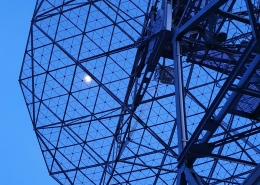
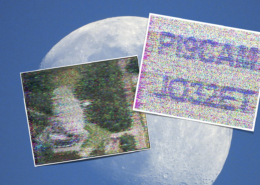
During the weekend of July 26-27th we established "receive experiments" with the Radio Telescope of Dwingeloo, DT. Jan van Muijlwijk wrote the following report.
The Dwingeloo Telescope follows the moon
Adobe Flash Player not installed or older than 9.0.115!
After the successful first EME weekend of May 10-11th various parts of the system have been improved. This weekend we expected to be able to check if these changes give the expected improvements to the system. Since the moon was high in the sky this time we expected a lot of active Ham’s on the band for EME activity.
We listened to CW and SSB signals on 70cm and 23cm.
Also JT65 signals were checked.
JT65 signals are produced with the help of a PC and also decoding is done in a very smart way, such that even very weak signals can still be decoded. Compared to ordinary CW decoding, JT65 signals can be more then 10dB weaker and still generate a perfect decoding. Since the introduction of this digital mode, more and more ham’s start to discover EME possibilities with their rather limited radio system and smaller antenna’s. More detailed information on this mode can be found on the website of the designer of JT65 Joe Taylor.http://physics.princeton.edu/pulsar/K1JT/
Since we are limited to receive only this weekend I invited Sven SM5LE to join us for some tests. He was prepared to run some test signals from Sweden.
Also we had an internet connection and were able to use various EME loggers to chat with other stations. When we turned the DT to the moon for the first time that weekend on Saturday at around 13.00hrs immediately a very strong CW signal was detected on 23cm from OZ6OL.
Also on 70cm we found our first JT65 signal originating from HB9Q. Dan uses a 15m dish and 1000Watt and generated the strongest signal heard so-far! After logging-in on the EME logger we were invited to listen to signals from Matej OK1TEH. Matej owns a small station consisting of a single 23 elements yagi and 750Watt RF power on 70cm.
His signals were clearly identified, our BIG ear is performing very well. After this success Matej wanted another try for 23cm, using a 1m Wifi dish and 80Watt of RF power. This is really QRP! Since the local temperature in Czechoslovakia was very high Matej was only able to run short transmit period. Never the less we were able to identify his signals on 23cm as well. In the afternoon we repeated this test on 23cm successfully with an even higher temperature in Matej’s shack of around 50degrees.
Coming back to the tests we run with Sven SM5LE, we were able to detect his SSB signals on 23cm, using a 2.2meter dish and 100Watt RF power.
Weak but positively readable we heard his voice from the speaker: “CQ CQ EME from SM5LE”
It is almost impossible to comment on every received signal we heard, therefore please find below an overview of the station received.
(For JT65 a different way of signal strength indication is used, compared to the ordinary way for CW/SSB. It uses negative dB’s; the more negative the weaker the signal. Signals detectable with JT need to be at least –31dB, while for CW you will need at least –21dB).
List of received stations at 70 cm.
HB9Q JT -1 dB OK1TEH CW 519 UA3PTW CW 579 W8TXT CW 559 KL6M CW 589 LZ1DX JT -4 dB RD6DA JT -11 dB YO5TP JT -22 dB
List of received stations at 23 cm.
OZ6OL CW 569 F2TU CW 599 + UT5JCW JT -3 dB PE1HNG JT -10 dB W7UPF JT -2 dB GW3XYW JT -4 dB SM5LE JT -7 dB SM5LE SSB 41 - 52 OK1TEH CW 419 VE7BBG JT -7 dB N2UO CW 579 WB2BYP CW 559 K2UYH JT -3 dB