Earth-Venus-Earth 2026: more results
In our recent Earth-Venus-Earth experiment, we managed to send a message from the amateur-operated Dwingeloo Radio Telescope to the amateur-operated Stockert Radio Telescope. But during part of the experiment, several professional radio telescopes also listened for the Venus-echoes of signals transmitted in Dwingeloo. The increased sensitivity made it possible to receive special waveforms.
The professional telescopes that listened in were the 100-m telescope of the MPIfR (Max-Planck-Institut für Radioastronomie) at Effelsberg and a large part of MERLIN, the UK-based array of telescopes, including the 76-m Lovell Telescope.
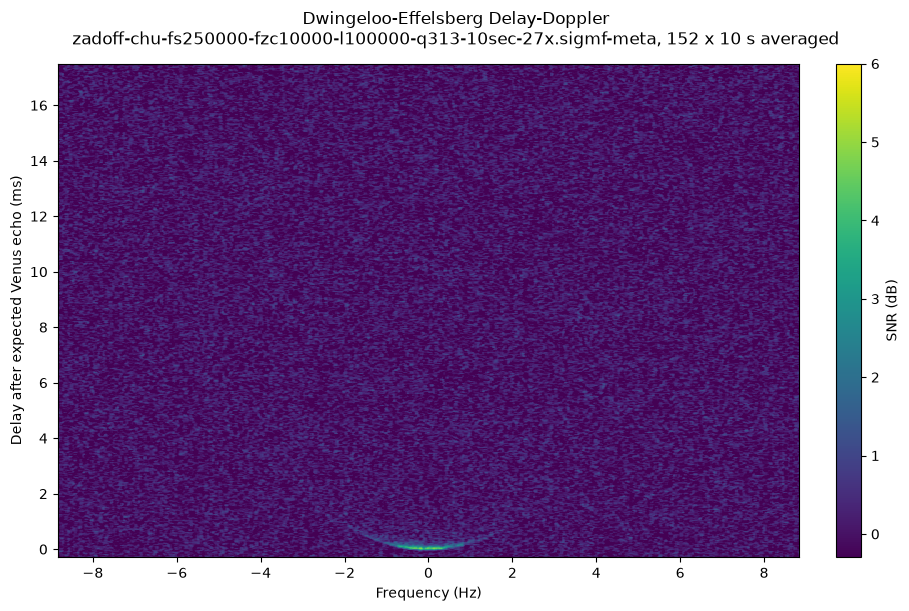
By sending a Zadoff-Chu sequence from Dwingeloo to Venus and receiving it with Effelsberg, we managed to resolve the Doppler and delay of Venus. We could receive (and distinguish) echoes from the front of Venus but also from up to 1 millisecond later, which corresponds to about 300km. Similarly, the different Doppler frequencies indicate a horizontal shift of the echo’s origin on the surface of Venus. This technique has been used in the past to make the best maps of Venus. This is the first time that amateurs have used this technique for Venus, with significantly lower power than were used in the 1960s.
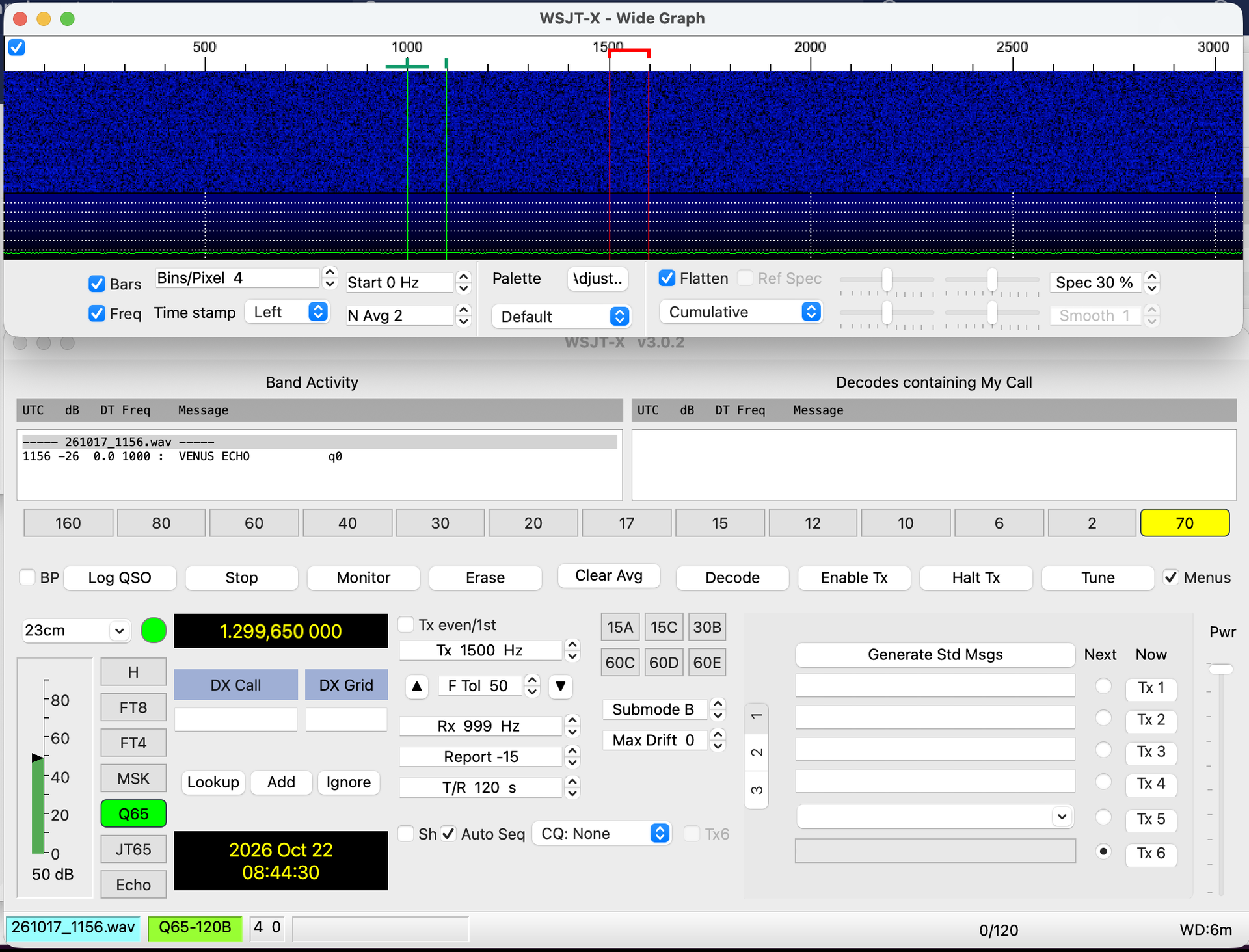
Another waveform we transmitted from Dwingeloo was Q65, an MFSK-variant used by many radio amateurs to transmit messages with extremely low signal-to-noise. It could be decoded only from the recording from Effelsberg, at 26 dB below the noise. In the echo from other telescopes, the remaining signal was too faint to be detected. The doppler-corrected wav-file which can be replayed in WSJT-X can be downloaded here.
With the increased sensitivity of Effelsberg, we also bounced a slow Morse signal: the letters ‘EVE’ (· ···– ·) spread over five minutes. When speeding up and averaging the reception, we could clearly distinguish these letters in Morse (unfortunately the first ‘E’ is missing due to a gap in the recording).