Earth-Venus-Earth 2026
This post presents results from an experiment that is still in progress. Results may be added later.
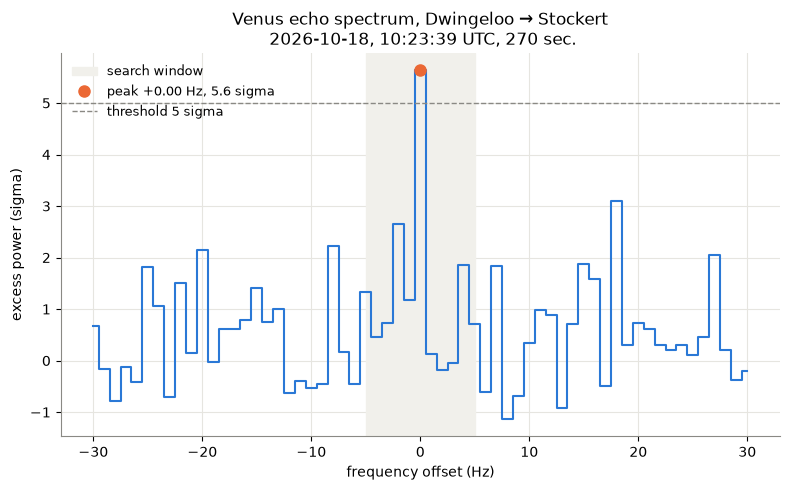
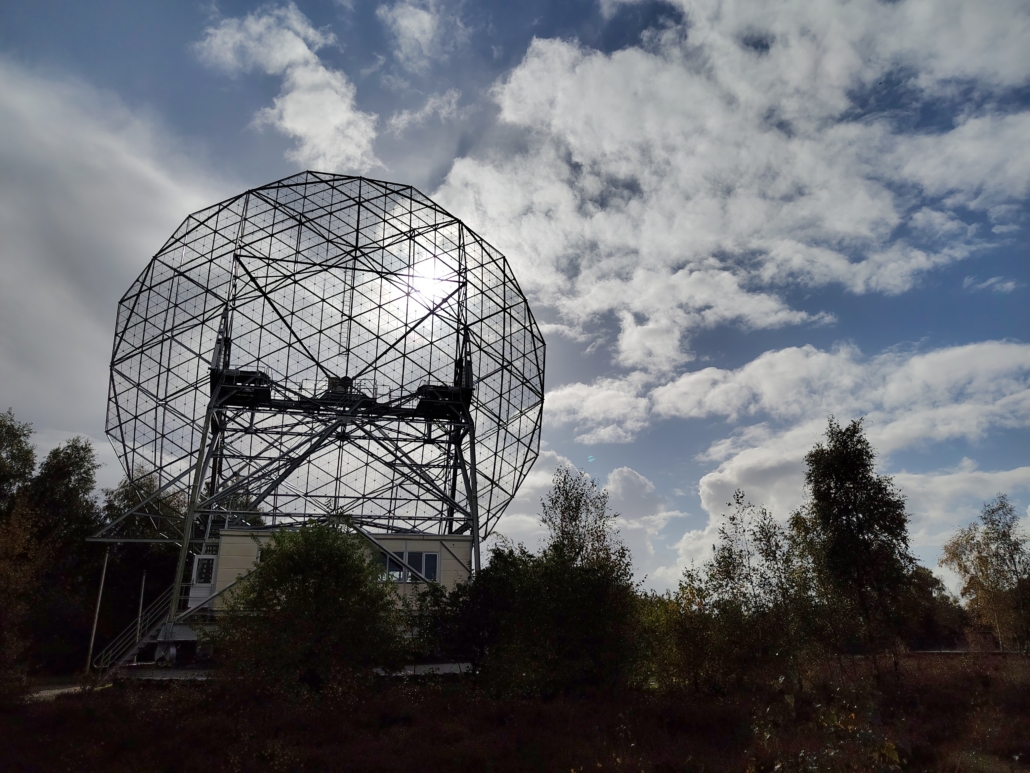
On 17 and 18 October 2026, the Dwingeloo Radio Telescope transmitted signals towards the planet Venus. The reflections from Venus were received by the Astropeiler Stockert. Both radio telescopes are operated by volunteers. The signals traveled about 42 million kilometers from Dwingeloo to Venus, and around the same distance back to Stockert, a round trip of almost five minutes. From the echoes, we successfully decoded a 10-character message: “VENUS ECHO”.
This ‘Earth-Venus-Earth’ (EVE) experiment is the next step after ‘Earth-Moon-Earth’ (EME) communication, also regularly performed from Dwingeloo. Transmitting a signal to Venus and receiving the echo was only done twice before by amateurs: in 2009 by AMSAT-DL and in 2025 by the same team as this year. We wrote about the 2025 experiment in this blog post.
Compared to 2025, we transmitted more than just the CW tone. The successfully received message was modulated in a specially designed waveform (M-FSK), in collaboration with the Open Research Institute (ORI). Decoding it required averaging over about 40 minutes of received echoes. Other waveforms transmitted included slow Morse code and Zadoff-Chu sequences. We have not recovered their echoes from the recordings.
Apart from Stockert, several professional radio telescopes also received the reflected signals of Venus. One of ASTRON’s dishes of the Westerbork Synthesis Radio Telescope (WSRT), equipped with a new ‘Ambient-L’ front-end, also decoded the reflected message. The 100 m Effelsberg radio telescope and the 76 m Lovell telescope, as well as other telescopes from the eMERLIN network, also listened on Saturday 17 October. An analysis of these signals will be done later.
A successful EVE experiment can only happen around Venus’ inferior conjunction, when it is closest to Earth. The precise conjunction will happen on the weekend of 24 and 25 October, when we will repeat the experiment to get even better reflections. While the high-power transmitter is installed, we will also do an EME experiment on 24 October, 18:00–22:00 UTC (20:00–24:00 CEST). Radio amateurs may be able to hear our signal even with relatively small dishes, when tuned to 1299.65 MHz. Our experiment will end with another session on Venus on Sunday 25 October.
The telescopes in Dwingeloo and Stockert are both operated by volunteers. Many volunteers of both sites contributed to this success.
We intend to publish the results of this year’s Venus echo experiment soon. All received raw data will be publicly available after the experiment.