The Milky Way Motion in Color
The Milky Way Motion in Color
The LAB HI Survey in Doppler Colors — with hands on instructions to watch yourself!
When we look up at night, we see stars. Together with our own star — the Sun — and its planets, we live among hundreds of billions of other stars and planets in a galaxy: the Milky Way. Yet we see only a tiny fraction of it. Even under the darkest skies, the naked eye reveals merely some 4,000 to 5,000 stars. The rest remains hidden because we are looking through a flat disk filled with dust and gas. These “cosmic mist banks” absorb visible light, rendering the stars behind them invisible. But between those stars and that dust, something else is flowing: hydrogen gas. Invisible to our eyes, yet clearly detectable by a radio telescope — such as the one in Dwingeloo. One might even say it was built for this very purpose. The entire “hydrogen sky” was first mapped there and published in the Atlas of Galactic Neutral Hydrogen. Thanks to this work, we now know not only that our galaxy spans roughly 100,000 light-years, but also that everything within it is in motion. Through creative processing of this historic dataset — now in 2025 — the various velocities have been given their own colours. The result is a striking image showing that we are riding a vast cosmic carousel: orbiting the galactic centre at a steady speed, overtaken by stars on inner orbits and slowly leaving behind those on outer ones.
Hydrogen Gas and 21 Centimetres
For many years, the Leiden professor Jan Oort attempted to study the rotation and structure of the Milky Way using optical instruments. He grew increasingly frustrated by the dust clouds in the galactic plane — those same “cosmic mist banks” — which block visible light. In the early 1940s, radio science emerged as a promising new way to explore the universe after Karl Jansky and Grote Reber detected radio emission from the Milky Way. Oort then assigned his student Hendrik van de Hulst a remarkable task: determine which radio spectral lines might exist — and at what frequencies.
Our galaxy is filled with neutral hydrogen, denoted HI. Hydrogen is the simplest and most abundant element in the universe and dominates interstellar space. Atoms of neutral hydrogen emit an extremely faint but distinctive radio signal. In April 1944, during a meeting of the Dutch Astronomical Society, Van de Hulst predicted that this signal would have a wavelength of 21 centimetres, corresponding to a frequency of 1420.4 MHz. An HI atom can be nudged by its surroundings into a slightly higher energy state. When it eventually returns to its lower state, it emits a 21-cm photon at precisely that moment. This process is known as the hyperfine transition: the spin of the electron flips relative to the spin of the proton (Wikipedia). Remarkably, this higher-energy state is extraordinarily stable — the spontaneous transition takes ten million years or more. The fact that we nonetheless observe a continuous 21-cm signal gives an impression of the truly immense size of these hydrogen clouds, containing countless HI atoms!
The 21-cm line — a line in the graphs astronomers obtain when plotting wavelength measurements — was first observed in 1951 by Harold Ewen and Edward Purcell at Harvard University. This was not done with a radio telescope, but with a relatively simple antenna mounted on the roof of Harvard’s physics laboratory, just large enough to capture the collective whisper of hydrogen in our galaxy (gb.nrao.edu). The observations were soon confirmed by teams in the Netherlands and Australia (Wikipedia). The Dutch group was led by radio engineer Lex Muller, who was already collaborating with Jan Oort. Muller designed the Dwingeloo radio telescope and supervised its construction, giving the Netherlands one of the first large-scale scientific radio astronomy instruments (camras.nl). Because radio waves are not blocked by dust, this allowed astronomers to map the entire Milky Way — even where optical telescopes see nothing. The 21-cm line thus became the primary instrument for studying our galaxy.
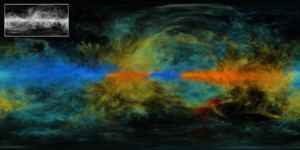
Figure 1 — The HI Survey in Colour (M. Meiborg, 2025) — 21-cm radio emission of the Milky Way rendered in Doppler colours, from the north to south celestial pole, all around. Blue regions move toward us; red regions move away. Inset top left: the original data.
Large-Scale Sky Survey
In the 1990s, the Dwingeloo Radio Telescope was used to conduct the first large, systematic sky survey of the 21-cm line. The Dutch astronomer Dap Hartmann and his team spent nearly six years collecting the observations. The resulting Leiden/Dwingeloo Survey (LDS) — published by Hartmann & Burton — mapped neutral hydrogen across the sky with unprecedented sensitivity and precision, except for a small region in the far south that is simply invisible from Dwingeloo, no matter how the Earth turns (academia.edu).
Later, between roughly 2000 and 2005, this work was extended with observations from the southern hemisphere by the Instituto Argentino de Radioastronomía (IAR). The combined data became the Leiden/Argentine/Bonn (LAB) Survey. After correcting for stray radiation and instrumental effects, the result was a complete all-sky map of HI emission, with exceptionally detailed information about the velocities of hydrogen gas relative to us (arXiv). Figure 1 shows the LAB data rendered in velocity-dependent colours.
Spiral Structure and Doppler Velocities
Why is this HI map so important? Because the radio line tells us not only where the hydrogen is, but also how fast it is moving. Under the influence of the galaxy’s gravity, gas clouds orbit the galactic centre. From our vantage point, we observe parts of that gas moving toward us and other parts moving away. As a result, the 21-cm wavelength becomes slightly shorter or longer depending on the direction of motion (Argelander-Institut für Astronomie). This is the familiar Doppler effect. We experience the Doppler effect whenever an ambulance passes: as it approaches, the siren sounds higher (shorter wavelength), and as it recedes, the tone drops (longer wavelength). The same principle applies to radio waves. Visible light behaves likewise: when its wavelength shortens, we perceive a shift toward blue; when it lengthens, a shift toward red. We cannot see HI frequencies or their shifts with the naked eye, but the intuitive rule “blue toward us, red away from us” allows us to visualize the motion of hydrogen throughout the galaxy.
In the 1950s, Jan Oort and his colleagues used this velocity information to determine the rotation of the Milky Way and, for the first time, reveal its spiral structure — something optical telescopes could never accomplish due to the thick dust clouds in the galactic disk (Wikipedia).
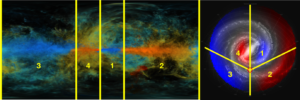
Figure 2 — The coloured map (M. Meiborg, 2025) shows four dominant velocity regions (left: 3, 4, 1, and 2), which can be translated into four major velocity zones around our position (right: surrounding the red circle). The calculations also revealed that HI clouds are concentrated in spiral arms.
The calculations showed that gas everywhere in the galaxy rotates around the centre at roughly the same speed: about 220 kilometres per second. This means that gas closer to the centre completes an orbit more quickly than gas farther out, simply because the distance is shorter. The same principle governs our planetary system: Mercury orbits the Sun in 88 days, Earth in one year, and Saturn in 29.5 years. Applied to the Milky Way, this implies that we are being overtaken by gas between us and the centre, while we in turn move away from gas on outer orbits. This explains why we observe four dominant velocity regions in the galactic plane. Where inner material overtakes us, outer material falls behind — producing two opposing velocity zones on either side of our own orbit. Moreover, because gas closer to the centre completes more revolutions in the same time, this naturally leads to the formation of the galaxy’s spiral arms. See Figure 2.
Bizarre Proportions
To put the HI research results into perspective: the Milky Way is about 100,000 light-years across. The orbit of our solar system lies roughly 26,000 light-years from the galactic centre. Travelling at 220 km/s (nearly 800,000 km/h), it takes about 230 million years for the Sun to complete one orbit. Since its birth, the Sun has made only about 20 such revolutions (4.6 billion years ÷ 230 million years ≈ 20). At this speed, we cover the distance of one light-year in about 1,400 years. In those 1,400 years, we advance merely 0.00219 degrees of our full 360-degree orbit. 0.00219 degrees back in history — around the year 600 — there was little scientific activity in Europe. Charlemagne would not be born for another 150 years. Yet the Indian astronomer Aryabhata (476–550) had already written that the Earth rotates — a truth that would only become widely accepted in Europe a millennium later through the work of Copernicus (1473–1543) and Galileo Galilei (1564–1642), defenders of the heliocentric model, in which the Sun — not the Earth — occupies the centre of the heavens (and even that centre later proved to be only local, not cosmic. Galileo nevertheless paid dearly: in 1633 he was sentenced to lifelong house arrest.
From Datacube to Doppler Colour Image
You can think of the Dwingeloo radio telescope as a camera with a single pixel. That pixel covers about half a degree of the sky. A full circle contains 360 degrees, so one sweep around the sky consists of 720 pixels (360° ÷ 0.5°). From north to south spans 180°, yielding 360 pixels. Thus, a complete sky map from Dwingeloo corresponds to an image of 720 × 360 pixels. But the LAB survey did not produce a single image. Instead, it generated a datacube — a dataset with a third dimension. For each pixel, the 21-cm signal was split into frequency channels, converted into velocities in steps of about 1 km/s, ranging from –450 km/s (toward us) to +450 km/s (away from us). This yields roughly 900 velocity layers for every pixel — in effect, 900 sky images of 720 × 360 pixels each.
From these, about 600 layers (–250 to +372 km/s) were selected; the remaining 300 would mostly add noise. Each layer was coloured by velocity — from blue (approaching) through the spectrum to red (receding). The layers were then stacked so that the dominant velocities rise to the surface, much like a Photoshop file with 600 layers. Where little or no gas is present, the layers become transparent, allowing underlying structures to remain visible. The result retains this transparency and can therefore be combined with other sky images. This colour-transparency composition was converted into an RGBA HiPS-set (Hierarchical Progressive Survey), which was published by the Strasbourg astronomical Data Center (CDS) and therefore available in the built-in survey catalogs of astronomical tools such as Aladin and Stellarium.
As result, HI velocity structures can be explored and compared with both optical and radio observations. See Figure 3.

Figure 3 — Example of a HiPS overlay in Aladin, the colored LAB HI survey and the Mellinger optical color survey.
Stellarium and Real-Time Measurements
Stellarium is a free, open-source planetarium program that displays the real sky on your screen — either in real time or at any chosen date and time. It is, in effect, a window on the universe with a built-in time machine, accessible to anyone interested in astronomy. At CAMRAS, Stellarium is linked directly to the control system of the Dwingeloo radio telescope and to the Doppler-colour HiPS dataset. This allows you to see:
- where the telescope is currently pointing,
- which Doppler colour (velocity) dominates that direction, and
- which HI frequencies are being detected live.
You are therefore watching historical survey data and present-day measurements side by side. See Figure 4. Over the past 20–30 years, the numerical changes are practically negligible: we have advanced only 0.000047° — one five-hundred-thousandth of a degree — along our orbit. The direct coupling of observation and visual context makes radio astronomy remarkably accessible to volunteers and visitors alike.
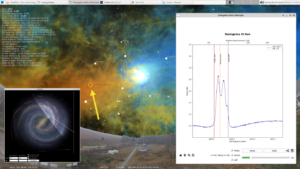
Figure 4 — Stellarium with the Doppler-colour HiPS, the telescope focus (yellow arrow), lower left: view through the galactic plane, right: live graph of HI frequencies for the focus point. Coloured lines trace spiral arms; the purple arm is our local arm, moving with us — showing no frequency shift — at exactly 1420.4 MHz — the true 21-cm line!
Why this is Fascinating
The combination of a classic all-sky dataset with modern visualization techniques reveals the true dynamism of the Milky Way. We see not only its structure — spiral arms and hydrogen clouds — but also its motion. By encoding velocity as colour, the HI map gains an extra dimension: time and movement made visible.
For anyone intrigued by radio astronomy, this opens an entirely new way of seeing — one that is both visually compelling and scientifically profound.
Hands on with Stellarium and Aladin
Below you will find practical instructions to explore the Doppler-colour maps yourself.
All HiPS datasets are hosted on the CAMRAS data site. You can view them directly in Aladin Web Viewer from the links below. These links are published by the CDS (Strasbourg Astronomical Data Center), therefore you can also load them directly in Stellarium and the desktop version of Aladin.
There are five available versions:
- CAMRAS – LAB HI Survey in Doppler Colors – RGB+Alpha
The original HiPS with transparency channel. Try this first in Aladin or any other HiPS-aware software. - CAMRAS – LAB HI Survey in Doppler Colors for Stellarium
RGB version without transparency. Stellarium does not support alpha channels; using the version above will therefore show oversaturated colours. Use this version in Stellarium. - CAMRAS – LAB HI Survey in Doppler Colors for Stellarium – DIMMED
Same as above, but with reduced colour intensity, in case the colours appear too strong in Stellarium. - CAMRAS – LAB HI Survey (monochrome)
Black-and-white version of the survey. Unlike the original LAB survey — Leiden/Argentine/Bonn (LAB) Galactic HI survey, which shows average values and therefore mainly reveals the galactic plane — this version displays the maximum velocity levels, making all hydrogen clouds visible. The original is useful to see where most HI activity occurs. - CAMRAS – LAB HI Survey – 3D CUBE – 891 layers
Only suitable for Aladin Desktop, which you can download and install. This is the complete data cube, allowing you to scroll through all velocity layers yourself.
Viewing with Stellarium
- If necessary, download and install Stellarium.
- Launch Stellarium.
- Open the Sky and Viewing Options window (F4), go to the Surveys tab, and scroll down until you see CAMRAS. All available HiPS versions will appear.
- Select the desired version. Note: Stellarium displays only one HiPS layer at a time.
- Return to the main screen and activate the chosen layer using the HiPS button in the bottom status bar (move the cursor down; the bar slides into view automatically).
- You can now “look around” the sky and explore the colours of the hydrogen gas.
At Dwingeloo, Stellarium is directly linked to the radio telescope: what you see in Stellarium corresponds to the live observation.
Viewing with Aladin
For those who want to explore further, Aladin is the ideal tool.
In this example we reproduce the view shown in Figure 3.
- If necessary, download and install Aladin Desktop.
- Launch Aladin.
- On the left you will see the catalogue panel.
- Type “Mellinger” into the search field at the bottom left. In the catalogue you will find Mellinger color optical survey.
- Click this survey and then click Load in the window that appears. The survey loads and becomes visible as a layer on the right side.
- Now type “CAMRAS” in the search field and repeat the steps for CAMRAS – LAB HI Survey in Doppler Colors – RGB+Alpha.
- The HI survey with transparency is now loaded on top of the Mellinger layer.
- Click the small box in front of the Mellinger layer so that a checkmark appears.
- Select the HI layer by clicking its name.
- The opacity slider below the layers now becomes active. Thanks to the transparency channel you can already see through regions without hydrogen, but with the opacity slider you can fine-tune the balance between the two layers.
Further reading…
Wikipedia — Hydrogen line
arXiv — The Leiden/Argentine/Bonn (LAB) Survey of Galactic HI. Final data release of the combined LDS and IAR surveys with improved stray-radiation corrections.
Argelander-Institut für Astronomie — Milky Way rotation – from 21cm line profiles 1 december 2011 — The hyperfine splitting of the ground state 2S is the source of the 21 cm hydrogen line. Frequency 1420.40575177 MHz. Page 8. 8. Properties of the HI 21-cm line.
Wikipedia — Jan Oort
universiteitleiden.nl — The Leiden/Argentine/Bonn (LAB) Survey of Galactic HI by PMW Kalberla · 2005 · — The LAB Survey is the most sensitive Milky Way H i survey to date, with the most extensive coverage both spatially and kinematically.
omp.eu — Leiden/Argentine/Bonn (LAB) Galactic HI survey 27 Nov 2023 — Leiden/Argentine/Bonn (LAB) Galactic HI survey. This survey correspond to 21-cm emission from Galactic neutral hydrogen over the entire sky.
harvard.edu —VizieR Online Data Catalog: Leiden/Argentine/Bonn (LAB) by PMW Kalberla · 2005 — The LAB survey contains the final data release of observations of 21-cm emission from Galactic neutral hydrogen over the entire sky,,,
harvard.edu — The Leiden/Argentine/Bonn (LAB) Survey of Galactic HI. … by PMW Kalberla · 2005 — We present the final data release of observations of λ21-cm emission from Galactic neutral hydrogen over the entire sky,,,
camras.nl — With the 21 cm hydrogen line from Kootwijk to Dwingeloo 28 Feb 2021 — This year marks the 70th anniversary since the 21 cm hydrogen line was first observed. American astronomers from Harvard were the first.
unlp.edu.ar The Leiden/Argentine/Bonn (LAB) Survey of Galactic HI – SEDICI by PMW Kalberla · 2005 — The LAB Survey is the most sensitive Milky Way H survey to date, with the most extensive coverage both spatially and kinematically.
nasa.gov — Foreground: LAB Survey. The LAB survey contains the final data release of observations of 21-cm emission from Galactic neutral hydrogen over the entire sky.Read more
arxiv.org — The Leiden/Argentine/Bonn (LAB) Survey of Galactic HI by PMW Kalberla · 2005 — The merged and refined material entering the LAB Survey of Galactic Hi is intended to be a general resource useful to a wide range of studies…
researchgate.net — The Leiden/Dwingeloo and Villa-Elisa All-Sky Galactic HI. 28 Oct 2015 — The Leiden/Dwingeloo survey of Galactic Neutral Hydrogen was published in 1997 (Hartmann & Burton 1997).
researchgate.net — Leiden/Argentine/Bonn (LAB) Survey of Galactic HI . The LAB survey contains the final data release of observations of 21-cm emission from Galactic neutral hydrogen over the entire sky.
uni-kiel.de — HI surveys of the Milky Way This tool shows the results from several surveys of galactic hydrogen, at the radio line of atomic hydrogen at 21 cm wavelength.
academia.edu — (PDF) HI shells in the Leiden-Dwingeloo HI survey. An algorithm of an automatic search for HI shells is presented and results of identifications in the Leiden-Dwingeloo HI survey.
icrar.org — Astrophysicists map the Milky Way. 20 Oct 2016 — Scientists have created a detailed map of the Milky Way using two of the world’s largest fully steerable radio telescopes in Germany and Australia.
youtube.com — A new all-sky survey of neutral hydrogen. This animation shows the HI 21-cm line emission of neutral atomic hydrogen of the Milky Way galaxy…