First data received from three Japanese cubesats
At the request of the SatNogs community we pointed the Dwingeloo radio telescope at the Japanese small satellite RSP-03 on 6 October. From this satellite, until then, only very faint signals had been heard. With the radio telescope’s sensitivity, it turned out to be possible to receive useful signals. Those signals can tell the Japanese team why the signals are so faint. The first data seem to show that there are antenna deployment issues.
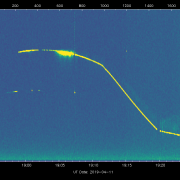
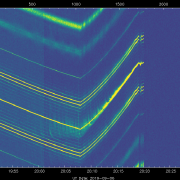
After the successful reception of RSP-03, we tracked a next cubesat from the same deployment: Birds-X DragonFly. Also from this satellite, we could receive faint signals. These Morse signals could be decoded; the results are visualized in the satellite’s dashboard. Also for this satellite, the received telemetry indicate that there is a problem with antenna deployment. We made some of DragonFly’s signals visible and audible below:
On 10 October, we tracked a third cubesat from the same deployment: GHS-01. To our knowledge, the signals of this cubesat had not been received before. The Dwingeloo telescope could receive faint signals, but there seems to be a problem with this signal, possibly due to an onboard failure. We could not decode GHS-01.
We have also attempted to receive yet another cubesat from this mission, STARS-Me2. Unfortunately we have not received any signal from this satellite.
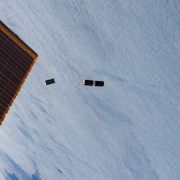
All of the above satellites were deployed from the ISS on 19 September 2025. It is remarkable that of this batch, every transmitting cubesat has faint signals. Possibly, some of the satellites will manage to deploy their antennas later on. Until then, we try to keep the satellite teams updated with telemetry by observing the satellites with the Dwingeloo telescope.
We received a digital QSL card from the teams of DragonFly and RSP-03.


 Cees Bassa

 JAXA
JAXA CC-BY-SA 4.0 CAMRAS Dwingeloo Telescope
 Cees Bassa